
Bikepacking Mistakes: What Experienced Riders Wish They Knew Before Their First Trip
◉ Bikepacking Mistakes: What Experienced Riders Wish They Knew Before Their First Trip
Content Type: Expert Bikepacking Guide
Category: Bikepacking Tips & Beginner Advice
Reading Time: 5–6 minutes
Summary 
◉The most common first-time bikepacking mistakes are packing too much, planning unrealistic daily distances, carrying too little water or food, skipping a fully loaded test ride, choosing poor routes, and making essential gear difficult to reach. Experienced riders often discover that successful bikepacking is less about owning perfect equipment and more about keeping the bicycle manageable, knowing where the next resupply point is, and leaving enough time to actually enjoy the journey.
There is a funny thing about a first bikepacking trip.
At home, everything looks wonderfully organized.
The route is saved. The bags are packed. The weather forecast looks friendly. You have enough equipment to survive a minor apocalypse.
Then somewhere around mile 37, the bicycle feels twice as heavy, the “easy gravel road” becomes a hill, and someone named Mike says:
“I thought there was a store here.”
There is no store.
Welcome to bikepacking.
Mistake #1: Packing for Every Possible Disaster
Overpacking may be the unofficial tradition of first-time bikepacking.
A rider who recently completed a first 400 km, six-day trip around Gotland admitted afterward that he had brought far too much, including extra clothing for hypothetical evenings at pubs. Another rider starting a solo trip across France realized on the very first day that the bicycle was carrying far more than necessary.
The problem is not simply weight.
More equipment requires more storage, makes packing slower, changes bicycle handling, and creates more things to search through every time you stop.
Before packing something, ask:
Will I realistically use this during this particular trip?
Your bicycle does not need to become a mobile apartment.
Mistake #2: Planning Too Many Miles Per Day
◉ Distance on a loaded bicycle is different from distance on your normal weekend ride.
Gravel, elevation, wind, heat, navigation mistakes, photographs, food stops, mechanical problems, and additional weight can dramatically change your average speed.
In one popular discussion about bikepacking mistakes, a rider said planning more than 140 km per day on the first trip was too ambitious. Later trips around 80 km per day provided more time to relax, set up camp, eat, and enjoy the destination.
That does not mean 80 km is the magic number.
It means your itinerary should include time for the unexpected.
Nobody returns from a beautiful trip saying:
“I wish I had looked at the landscape less.”
Mistake #3: Assuming Water Will Appear Somehow
Water planning sounds obvious until it goes wrong.
Experienced riders repeatedly mention passing a refill opportunity because they assumed another one would appear farther along the route. Sometimes it does.
Sometimes it absolutely does not.
Before riding through remote areas, identify reliable water sources and understand how much capacity you need between them.
The same applies to food.
One cyclist described accidentally leaving most of his food at camp and finishing the day with an extremely creative dinner involving peanut butter, ham, and gummy worms.
Funny afterward.
Considerably less funny when hungry.
Mistake #4: Never Testing the Fully Loaded Bicycle
Your bicycle can feel perfect unloaded and completely different after adding camping equipment, water, food, and bike bags.
One first-time rider reported that the loaded bicycle handled badly on gravel and immediately started reconsidering weight distribution and whether more weight should move into a frame bag.
This is why a shakedown ride is so valuable.
Load the bicycle exactly as you intend to travel and ride it before the real adventure.
Climb. Descend. Brake. Ride rough surfaces. Open every bag.
You may discover that something rubs, swings, rattles, blocks a bottle, or requires removing three other things every time you want a snack.
Better to discover that five miles from home than fifty miles from civilization.
Mistake #5: Putting Everything in the Wrong Place
Packing is not only about fitting everything onto the bicycle.
It is about where everything lives.
Heavy items generally benefit from stable positions that help preserve predictable bicycle handling. Frequently used items should remain accessible.
Snacks, phone, navigation essentials, sunglasses, small tools, and other things needed repeatedly during the day should not require unpacking your sleeping system.
This is where a modular bike bag system becomes useful.
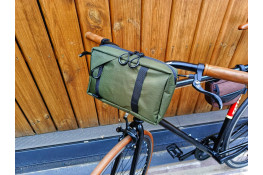
A frame bag can organize tools and denser equipment. A top tube bag or feeder can keep frequently used items accessible. A handlebar bag can carry appropriate lightweight gear, while saddle bags, trunk bags, or panniers can handle additional capacity depending on the bicycle and route.
Good packing should make the ride simpler, not create a daily treasure hunt.
Mistake #6: Trusting the Route Without Question
A line on a navigation app is not always a beautiful gravel road.
Sometimes it is mud.
Sometimes it is a fence.
Sometimes it appears to have been designed by a person who has never encountered a bicycle.
A first-time solo rider in France described trying to choose quieter roads and ending up in pastures surrounded by fences. Other bikepackers have reported navigation mistakes involving unexpectedly difficult terrain and closed routes.
Check several sources when planning unfamiliar areas, especially remote sections.
And always allow yourself permission to change the route.
Adventure does not become invalid because you turned left instead of right.
Mistake #7: Waiting for the Perfect Bikepacking Setup
This might be the most expensive mistake of all.
Not because of money.
Because of lost adventures.
One rider looking back on early bike camping said they had waited because they believed they needed a “proper” setup, then realized a simple bicycle and basic camping equipment would have been enough to start.
You can improve equipment after experience teaches you what actually matters.
Your first trip does not require the perfect bicycle, the lightest tent, or the most fashionable collection of bags on Instagram.
It requires a bicycle that works, essential equipment, sensible planning, and somewhere you genuinely want to go.
Your First Trip Is Supposed to Teach You Something
Perhaps this is the most important lesson. You will probably make a mistake.
Maybe Sarah packs four shirts and wears one. Maybe Tom discovers that carrying a luxury pillow uphill was an interesting life choice.
Maybe you arrive home and immediately move half your equipment into different bags.
That is not a failed bikepacking trip.
That is how your personal cycling system develops.
At LESENOK, we create handmade Colorful Cycling Systems with more than 100 bike bag models, 50+ colors, and selected custom-size options for gravel riding, touring, commuting, and bikepacking.
But even the perfect bag cannot decide what you actually need.
Experience does that.
Pack. Ride. Learn. Change something. Ride again.
Short Summary
Common bikepacking mistakes include overpacking, planning excessive daily mileage, underestimating food and water needs, skipping a loaded test ride, poor weight distribution, blindly trusting navigation, and waiting for perfect equipment before starting. A short shakedown ride and a simpler packing system can prevent many problems before a longer adventure begins.
About LESENOK
◉ LESENOK creates handmade colorful cycling bags and modular storage systems for commuting, gravel riding, touring, and bikepacking. With 100+ models, 50+ colors, and selected custom-size options, cyclists can build a carrying system around their bicycle, route, and personal style of adventure.

How can we help?