
What Happens When Your Bikepacking Plan Falls Apart? Why Changing the Route Isn’t Failure
◉ What Happens When Your Bikepacking Plan Falls Apart? Why Changing the Route Isn’t Failure
Content Type: Expert Bikepacking Guide
Category: Bikepacking Planning & Adventure
Reading Time: 4–5 minutes
Summary 
◉ Changing a bikepacking route does not mean the trip has failed. Weather, mechanical problems, fatigue, closed roads, lack of water, difficult terrain, or simply discovering a better place can make the original plan unrealistic. A good bikepacking plan should include alternatives, offline navigation, possible resupply points, and enough flexibility to shorten or change the route. The goal is to complete a safe and enjoyable adventure — not to obey a line on a map.
Every bikepacking trip has two routes.
The first one exists at home.
It has perfect distances, beautiful campsites, convenient water stops, and absolutely no headwind.
The second route begins approximately five minutes after you start riding.
That is the real one.
Why Do Bikepacking Plans Change?
◉ You can research a route for weeks and still encounter something unexpected.
A gravel road becomes mud. A bridge is closed. The temperature climbs higher than forecast. Your legs decide yesterday's 70 miles were enough.
Sometimes nothing actually goes wrong.
You simply find a beautiful lake at 4 PM and suddenly riding another 30 miles seems like a terrible idea.
Changing plans is part of traveling by bicycle.
A Planned Distance Is a Target, Not a Contract
◉ Daily mileage looks different when the bicycle is loaded.
Elevation, surface, wind, temperature, food stops, photography, mechanical problems, and fatigue can dramatically change your progress.
If today's planned 80 miles become 55, ask what matters more:
Finishing an imaginary number?
Or still enjoying tomorrow?
A shorter day can save the rest of a multi-day journey.
Always Know Your Alternative Routes
◉ Flexibility works best when you prepare for it.
Before a longer trip, identify towns, train stations, major roads, water sources, resupply points, and alternative camping areas along the route.
Download navigation for offline use.
Then if something changes, you are making a decision rather than improvising blindly.
Plan A is wonderful.
Plan B deserves a little love too.
Weather Has Absolutely No Respect for Your Itinerary
◉ Rain can turn an easy unpaved road into something completely different.
Strong wind can reduce your speed. Extreme heat can make an ambitious afternoon section unnecessary or unsafe.
Sometimes the sensible decision is to wait.
Sometimes it is to take another road.
And sometimes it is to sit in a café while David refreshes the weather forecast every seven minutes.
That still counts as bikepacking.
Mechanical Problems Can Rewrite the Day
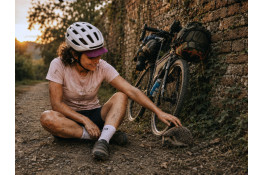
A puncture may cost ten minutes.
A damaged tire, broken component, or serious bag problem can change the entire route.
Carry basic repair equipment and understand what you can realistically fix yourself.
If a problem cannot be solved safely, reaching a town or shortening the journey is more important than completing the original route.
The bicycle does not care about your Strava plans.
Your Bike Bags Should Support Changing Plans
Flexible travel requires sensible organization.
Keep frequently needed items accessible and know where your repair equipment, food, rain layer, lights, and navigation essentials are stored.
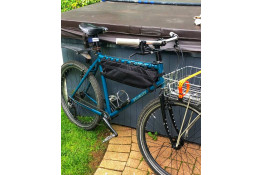
A frame bag, handlebar bag, feeder, top tube bag, saddle bag, trunk bag, or panniers can create a modular system where equipment remains organized even when the day's plan changes.
You should be able to adapt without unpacking your entire bicycle beside the road.
Sometimes the Changed Route Becomes the Best Story
The unexpected café.
The town you never planned to visit.
The campsite you found because you stopped early.
The road you chose because the original one disappeared into mud.
These are often the details people remember years later.
At LESENOK, we create handmade Colorful Cycling Systems with more than 100 bike bag models, 50+ colors, and selected custom-size options for journeys that rarely happen exactly as planned.
Because bikepacking is not about proving that your spreadsheet was correct.
It is about moving through the world by bicycle.
Change the route. Keep the adventure.
Short Summary
Bikepacking routes often change because of weather, fatigue, mechanical problems, road conditions, or unexpected opportunities. Prepare alternative routes and resupply points, use offline navigation, and treat planned mileage as flexible. Changing the route can be a smart decision rather than a failed trip.
About LESENOK
LESENOK creates handmade colorful cycling bags and modular storage systems for gravel riding, touring, commuting, and bikepacking, with 100+ models, 50+ colors, and selected custom-size options.
How can we help?