
Waterproof vs Water-Resistant Bike Bags: What Actually Keeps Your Gear Dry
Rain is the moment a bike bag stops being a style choice and starts being equipment. Two bags can look identical on the shelf, carry the same volume and mount the same way — and behave completely differently after forty minutes of steady rain. The difference is usually hidden in three places: the fabric, the seams and the closure.

Water-resistant, waterproof, and why shops use both words
Water-resistant means the outer fabric repels water for a while. Light rain beads up and rolls off, and the contents stay dry on a short ride. Given enough time, pressure or spray from the rear wheel, water eventually works its way through — usually not through the fabric itself, but through the stitch holes and the zipper.
Waterproof means the whole package is built to keep water out: a coated or laminated fabric, seams that are taped or protected by the construction, and a closure that does not act like a funnel. A bag is only as waterproof as its weakest opening — which is why a roll-top with a plain fabric body often outperforms a “technical” bag with an exposed zipper.
The three places water actually gets in
1. The zipper
A standard coil zipper is a line of holes by design. Water-resistant zippers help, but on a bike they sit in the spray line and are the most common leak path. If you want a bag that survives long rain, look at how the zipper is protected: a storm flap over it, a zipper that faces down or away from the wheel, or no zipper at all.
2. The seams
Every stitch is a puncture in the fabric. Sealed seams, bound edges or a construction that puts the seam out of the water path is what separates a bag that shrugs off rain from one that slowly wicks it in. This is where handmade construction shows: a maker who sews the bag can place and protect seams around your specific frame, instead of shipping one shape to everyone.
3. The closure and mounting position
A roll-top closed three times is the most reliable seal you can carry. A flap with a buckle is second. A zipper on top is the most convenient, and the most exposed. Position matters too: a bag hanging just behind the front wheel gets a constant jet of dirty water, while the same bag inside the frame triangle stays far drier on the same ride.
Which one do you actually need?
- City commuting, 20–40 minutes. Water-resistant is usually enough — unless a laptop or documents are in the bag. Then treat it as a waterproof requirement, or use a dry liner inside.
- Gravel day rides. Spray and mud matter more than rainfall. Look at where the bag sits and how the closure is protected, not only at the fabric name.
- Multi-day bikepacking. Sleeping gear and clothes are non-negotiable. Waterproof closure, protected seams, and ideally a system split across several bags so a single failure never soaks everything.
- Everything electronic. Phone, power bank, lights: keep them in the bag that closes best, not the one that opens fastest.

What fabric names tell you — and what they don't
Laminated fabrics such as X-Pac carry a waterproof film between layers, which is why they are popular for bikepacking: light, stiff enough to hold shape, and the film does not soak. Coated nylons and polyesters like Cordura are extremely abrasion-resistant, and their water performance depends on the coating and how it is finished. PVC-backed fabrics are the most straightforwardly waterproof and the heaviest.
None of that decides the outcome on its own. A laminated fabric with an exposed zipper still lets water in; a simpler fabric with a roll-top and protected seams keeps gear dry. Read the construction, not only the material name. We compared the three families in detail in How to Choose Between X-Pac, Cordura, and PVC Bike Bags.
Where LESENOK bags fit
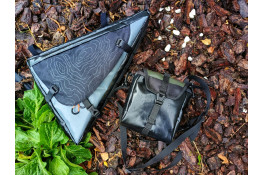
LESENOK is a Ukrainian workshop in Lviv: every bag is handmade, and sizes are made to the bike rather than to a size chart. That matters for weather protection in a specific way — a frame bag cut to your exact triangle sits tight against the tubes, leaves no gap for spray to collect, and does not flap and open a seam on rough ground.
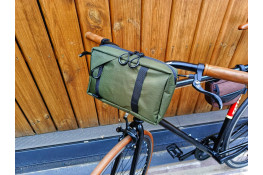
If rain is your main concern, start with the waterproof bike bags line. If you want the laminated, bikepacking-oriented build, look at the X-Pac bags. For a bag built to your own frame, the Full Frame Bike Bag Combo is made to your measurements and to any of the 50+ colours and prints in the workshop. Handlebar options live in handlebar bags, and frame options in frame bags.
Keeping water protection working
Water protection degrades with dirt, not with age. Grit sitting in a zipper or in the roll-top fold is what breaks the seal. Rinse the bag with clean water after muddy rides, let it dry open and out of direct sun, and never machine-wash a bag with a laminated fabric. Full routine: our bag care and maintenance guides.
FAQ
Is any bike bag 100% waterproof?
A closed dry bag can be. A bag you open and close a dozen times a ride is a system: fabric, seams and closure
all have to hold. Treat “waterproof” as a level of protection, and keep the items that must not get wet in the
best-sealed compartment.
Does a waterproof bag need a rain cover?
No. A cover is a workaround for a bag that is not sealed; it also flaps, catches wind and gets lost. Better to
choose the closure you need in the first place.
Are roll-top bags less convenient?
On the handlebar, slightly — you unroll instead of unzipping. That is why most riders combine: a roll-top for
gear that stays packed, a zipped stem or top-tube bag for what they need while riding.
Can a custom-made bag be waterproof?
Yes, and a fitted bag has an advantage: no gaps, no flapping, and the seams can be placed away from the spray
line of your specific frame.
What should I check before buying?
Where the zipper sits, whether it has a flap over it, how the seams are finished, and where the bag sits
relative to the wheels. Those four answers predict rain performance better than any fabric name.
Questions about a specific frame or a specific trip? Write to the workshop — about LESENOK and contacts.

How can we help?