


Surly Disc Trucker Bags: Building a Touring Load
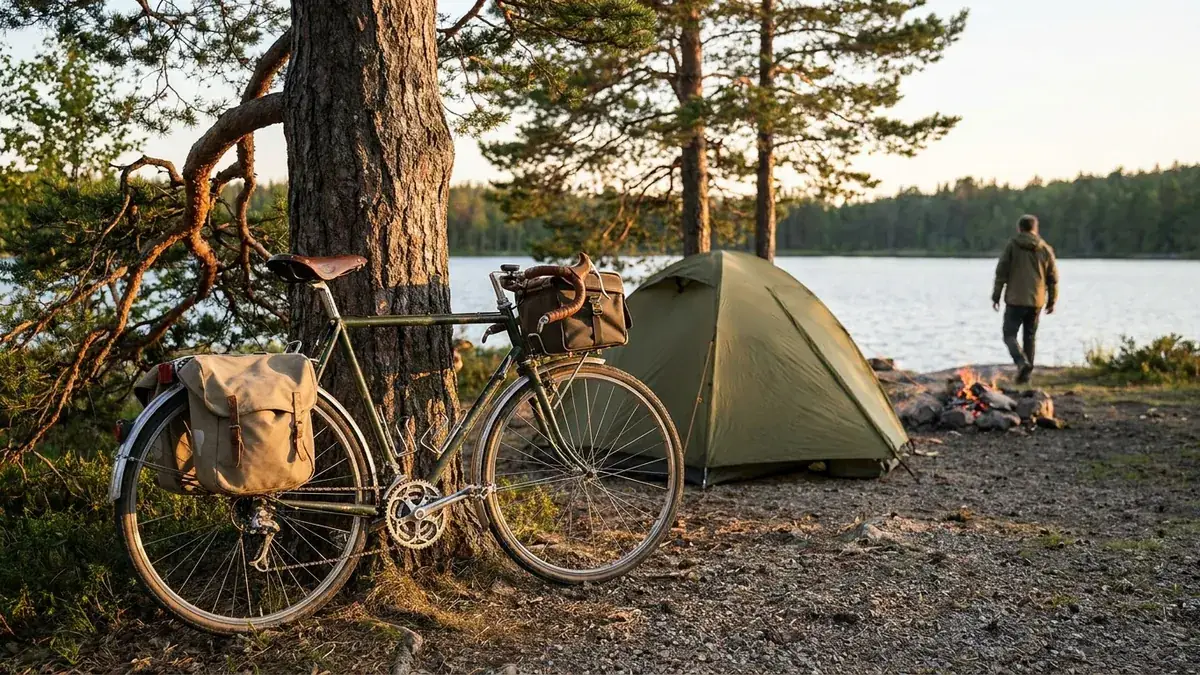
A loaded touring bike is built from the back forward. The rear rack goes on first, then the panniers that hang from it, then a bag on top, and only then the fork, the handlebar and the saddle. The Surly Disc Trucker suits that order well: Surly calls it a "pure-bred drop bar touring bike suitable for traveling anywhere in the world on mostly paved roads", and gave it, in its own words, "every braze-on you'll ever need for racks".
Fit a rear rack and two panniers first, add a trunk bag on top of the rack, then decide between front panniers and the fork's three-pack mounts. A dropper post is not compatible with the Disc Trucker, so a small saddle bag on the 27.2 mm post works without any compromise. Long Haul Trucker owners can follow the same order but have no bottle mounts on the fork.
What the frame gives you
The current Disc Trucker has a 4130 chromoly double-butted main triangle and a fork with rack mounts at the top, the bottom and mid-blade, plus two three-pack mounts. Front and rear fender mounts, three bottle mounts on the frame, a spoke holder on the seatstay and a Surly Truckstop drop bar complete it. Complete bikes come with a removable kickstand plate — handy for a bike that will stand fully loaded outside shops and campsites.
Wheel size depends on the frame: smaller sizes use 26-inch wheels, larger sizes 700c. Check which wheel your frame size uses on your own bike's spec sheet before you buy front panniers or fenders. Tyre clearance is 26 x 2.0–2.1" on the small wheel and 700c x 47 mm on the big one, with or without fenders.
Step 1: rear rack and panniers
The rack comes first because everything else depends on it. The rear rack eyelets are there; the choice of rack is yours. Our guide to choosing a rear rack for bike bags explains what to look for, and the short version is to buy the rack before the bags.
Then the panniers. The current frame has a slightly shorter chainstay than the previous one, so heel clearance deserves a check: with the pannier on the rail, turn the crank and look at where your heel passes. If it is close, slide the bag back along the rail. Our checklist will a pannier fit your rack covers the four measurements that decide it.
If you would rather start with one bag than a pair of panniers, the RANDONE is a rear rack bag sold as a single bag. It attaches with three straps at the bottom and one at the front, and has a reinforced bottom and several exterior pockets. Check on the product page how it sits on your rack before you plan the rest of the layout around it.
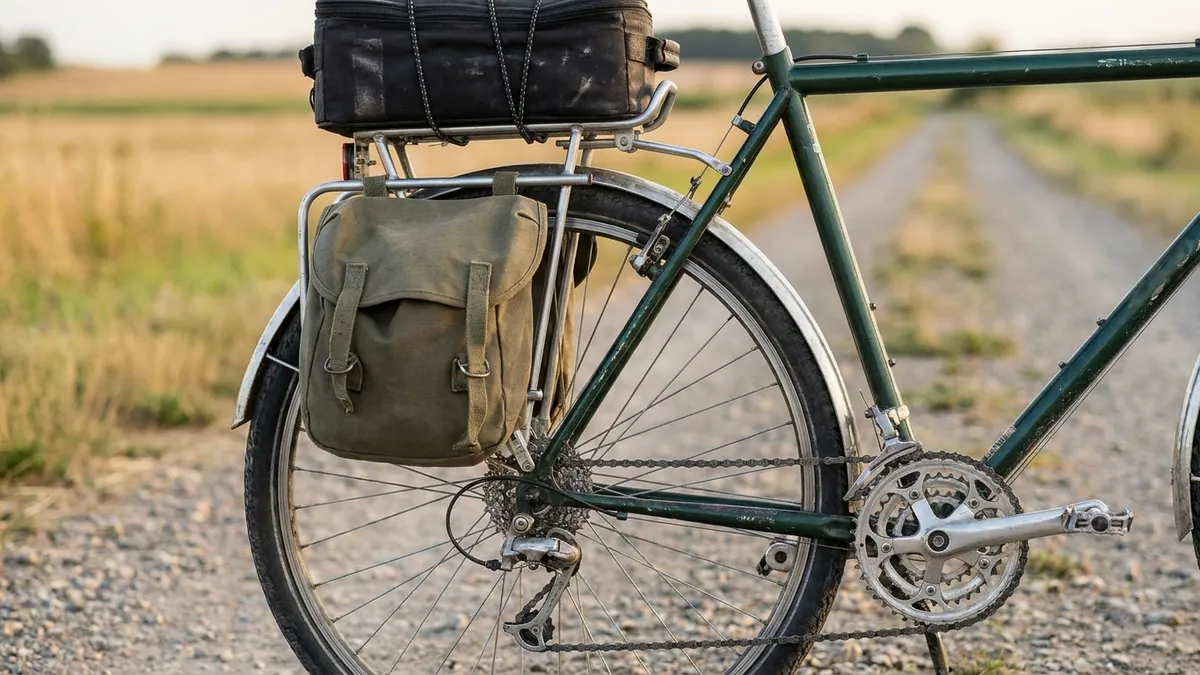
Step 2: the bag on top of the rack
The flat top of the rack between the panniers is the easiest place to reach. It is where the rain jacket, the lunch and the lock go — things you take out several times a day. The top-of-rack version of PROSTIR sits on the rack rather than at its sides, measures 30×30×12 cm, fastens at five points and has a carry handle for taking it into a shop or a tent. A roll-top such as FEST does the same job with hook-and-loop straps and buckles.
If you want more choice, our trunk and rack bags include bags for front, rear and fork racks.
Step 3: the fork
Here the two Surly Disc Trucker generations part ways. Both have rack mounts at the top, bottom and mid-blade of the fork, so either takes a front rack and front panniers. Only the current generation adds the two three-pack mounts, which take cargo cages for bottles or small dry bags.
Which to choose depends on the trip:
- Weekend or a week between towns. Two rear panniers and a trunk bag are often enough. The fork stays empty or carries two bottles in cages.
- Long tour with camping and cooking. Add a front rack and two front panniers for the dense, heavy items. This is the classic four-pannier layout.
- Light, mixed-surface trip. Cargo cages on the three-pack mounts with small dry bags, and no front rack.
Keep the left and right sides even wherever you carry weight on the fork.
Step 4: cockpit and saddle
The last two positions are for small, frequently used items.
- Handlebar. A handlebar bag on the drop bar for the phone, wallet and map. Leave room for your hands on the tops.
- Saddle. The Disc Trucker takes a 27.2 mm seatpost and is not compatible with a dropper, so the saddle stays at one height and a small saddle bag never has to dodge the tyre. Our saddle bags are the small kind — the SD-3 and MINI-1. With a rear rack and panniers you rarely need more volume there; if you do want a large seat pack, it is best used with a dedicated support rack.
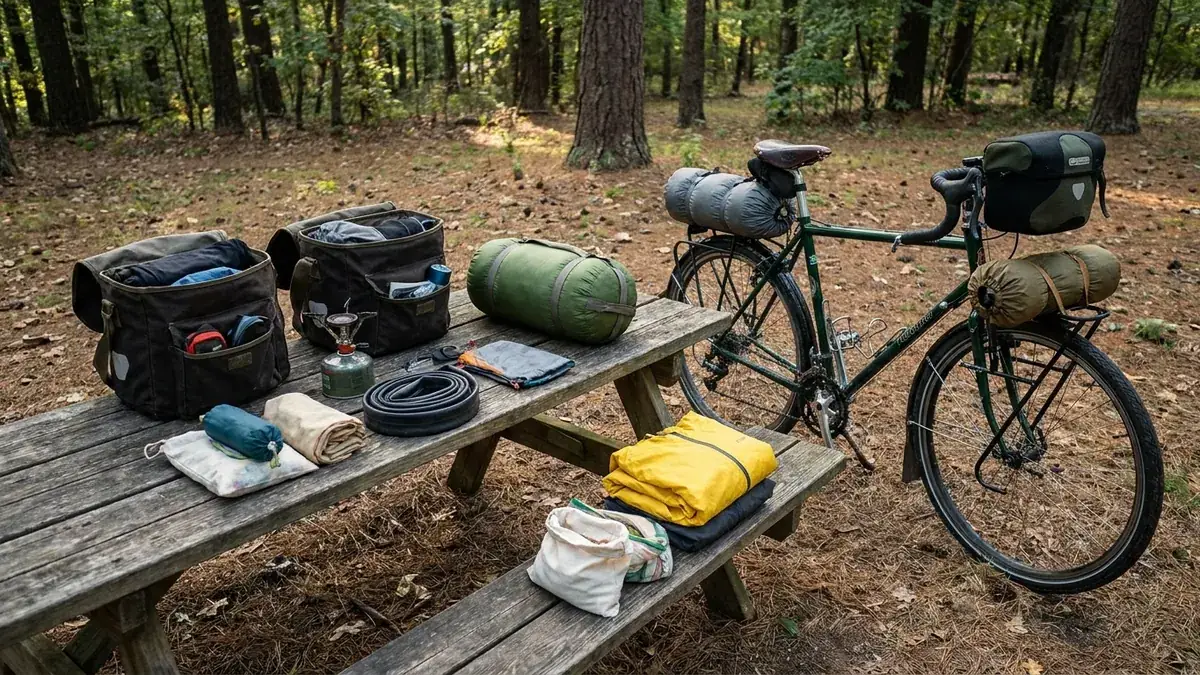
Packing a touring load by weight
Laid out on a table before a trip, the kit sorts itself into three piles. Heavy and dense: food, stove, fuel, tools, spare tubes. Bulky and light: sleeping bag, tent body, clothes. Small and often needed: phone, wallet, snacks, rain jacket.
The dense pile goes low — in the bottom of the rear panniers or in front panniers on the fork. The bulky pile fills the rest of the panniers. The small pile goes to the trunk bag and the handlebar bag. Our panniers and trunk bags shed rain but are not fully waterproof; a dry bag or liner around the sleeping bag and the electronics keeps a wet week from becoming a wet night.
For Long Haul Trucker owners
The Long Haul Trucker was the rim-brake version of the same idea, also a drop-bar bike for mostly paved roads, and it has been discontinued. It shares most of what matters for bags: 4130 CroMoly frame, front and rear rack mounts, fender eyelets, three bottle bosses on the frame, a kickstand plate, a spoke holder and a pump peg. It was made with 26-inch wheels in sizes 42–58 and 700c in sizes 56–62, and takes 700c x 42 with fenders or 45 without.
The difference for bags is the fork: there are no bottle mounts on it. So either carry water in the three frame positions and a bag, or fit a front rack and use the fork for panniers. Bar-end shifters on the Long Haul Trucker mean the cables come out of the bar ends, so check that a handlebar bag does not press on them. The previous Disc Trucker is similar: no fork bottle mounts, a Salsa Cowbell flared drop bar, and 700c x 42 with fenders or 45 without.
In short
- Build a Surly Disc Trucker from the back: rear rack, panniers, trunk bag, then fork, handlebar and saddle.
- Check heel clearance on the rear panniers; slide them back if needed.
- Current fork: rack mounts plus two three-pack mounts. Previous fork and the Long Haul Trucker: rack mounts, no bottle mounts.
- No dropper compatibility means a small saddle bag works on the fixed 27.2 mm post.
Questions we get asked
Can I put cargo cages on a Disc Trucker fork?
On the current generation, yes: the fork has two three-pack mounts. The previous Disc Trucker and the Long Haul Trucker have no bottle mounts on the fork.
Is a RANDONE sold as a pair?
No, RANDONE is sold as one rear rack bag. Its product page describes a single bag, so if you need bags for both sides of the rack, write to us before ordering.
What goes in a bag on top of the rear rack?
Things you reach for during the day: rain jacket, food for the day, a lock. The top-of-rack PROSTIR has a carry handle, so it comes off with you into a shop.
Do panniers hit my heels on a Disc Trucker?
It depends on your feet, crank and bag. Turn the crank with the pannier on the rail and slide the bag back if your heel comes close.
Is the Long Haul Trucker still made?
No. Surly discontinued the Long Haul Trucker; the Disc Trucker continues as its touring model.
Send us a photo of your Trucker and its rack at [email protected], and we will help you choose bags that fit it.
About LESENOK
LESENOK makes handmade Colorful Cycling Systems — bike bags for commuting, touring, family rides and bikepacking. Over 100 models, more than 50 colours and prints, custom sizes cut to your own bicycle, and worldwide shipping with tracking. Handmade in Ukraine. In-stock items are processed in 1–3 business days; made-to-order and custom bags are typically produced in 7–12 business days. Questions: [email protected].