


How to Carry Water Bikepacking: Where Bottles Ride
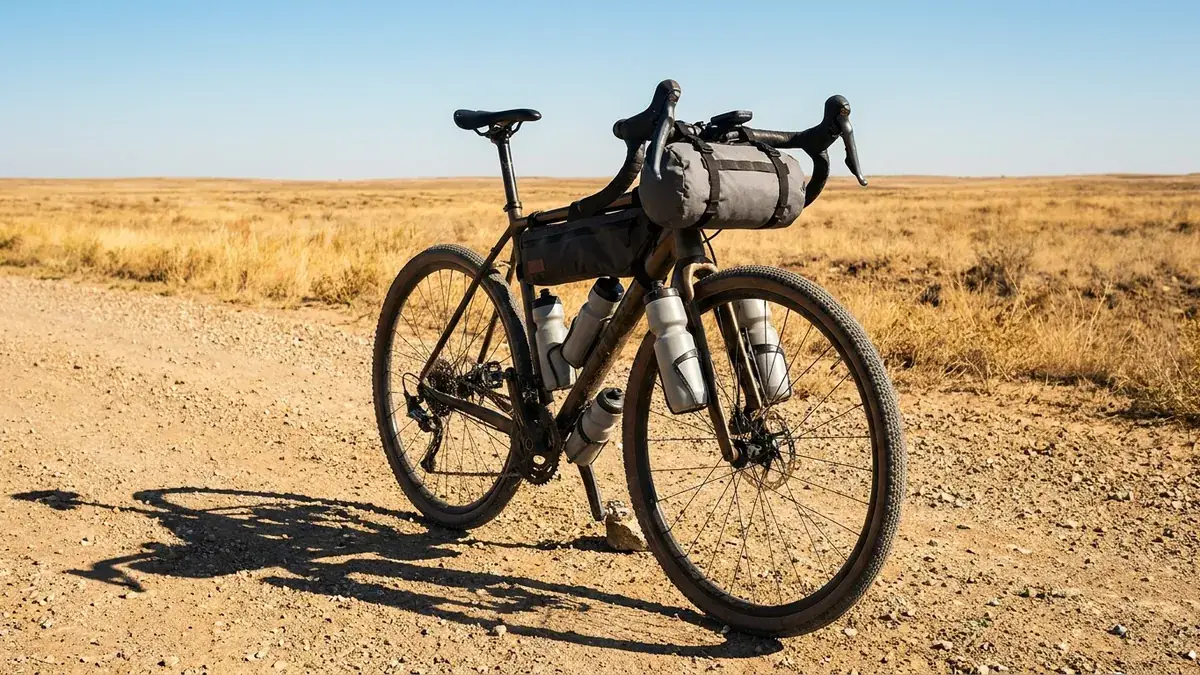
Water is the heaviest thing on a bikepacking trip, and the only thing you cannot pack less of when it gets hot. A frame full of food and a sleeping bag on the bars leave few places for bottles, so deciding how to carry water on a bike is part of planning the bags, not an afterthought. The answer is different on every bike, but the options are the same: the triangle, the underside of the down tube, the fork, the cockpit and your back.
The simplest way to carry water bikepacking is low and spread out: bottles in the frame triangle if your frame bag leaves room, a bottle under the down tube, cages on both fork legs, and a feed bag beside the stem for the bottle you drink from. Heavy water high on the handlebar or behind the saddle makes the bike harder to steer. Plan capacity from the longest gap between refills on your route, not from a fixed number.
Six places a bottle can go
Each spot has a cost. Here they are side by side, then one by one.
| Location | Good for | Watch for |
|---|---|---|
| Inside the triangle | Daily drinking, lowest centre of weight | Competes with the frame bag |
| Under the down tube | Reserve bottle | Mud, spray, bottles shaking loose |
| Fork legs | Large bottles, spare capacity | Needs fork mounts and a load limit check |
| Feed bag at the stem | The bottle you reach while riding | Bottle has to fit the bag |
| Bladder in the frame bag | Big volume in a flat shape | Takes space from food and tools |
| Hip pack or backpack | Emergency extra | Load on your back and hands |
Inside the frame triangle
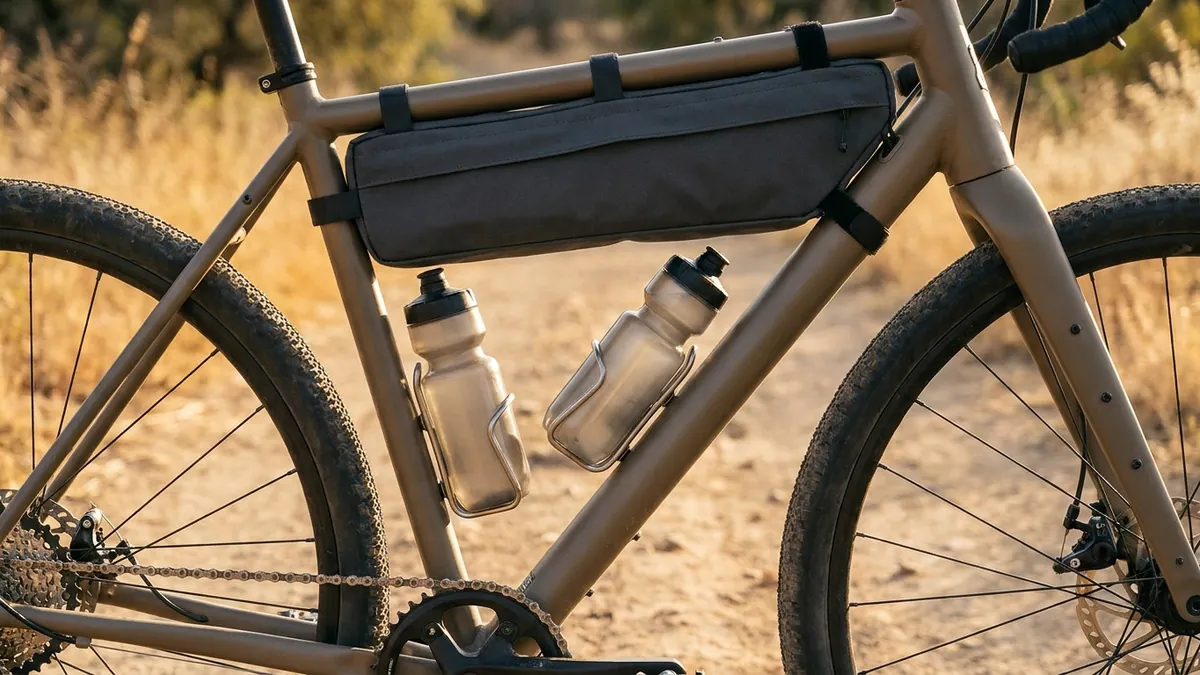
The classic bike water bottle holder on the seat tube and down tube puts water in the best spot on the bike: low, central and within reach. The catch is that a full frame bag takes the same space. You choose between volume for gear and room for bottles, which is the main question in our comparison of full frame bag vs half frame bag.
A half frame bag sits along the top tube and leaves the lower part of the triangle for cages. Our LONG custom half frame bag is made to your measurements so the bottles below still have room. How much room depends on your frame geometry, your cages and the size of bag you choose, so measure with the bottles in place and allow space to lift them out of the cage. On small frames, side-loading cages help.
Under the down tube
A third set of bosses under the down tube takes one more bottle. It is low and out of the way, but right in the spray from the front tyre, and on rough ground a bottle can rattle out of an ordinary cage. Use a cage that grips firmly or add a strap, and keep the drinking bottle somewhere cleaner. It suits reserve water for camp.
Fork legs
If the fork has mounts on each leg, it can carry a lot. Two-bolt mounts take an ordinary bottle cage. Three-bolt mounts take a larger cargo cage, the kind riders often call an anything cage, which holds a big bottle or a small dry bag. Keep left and right roughly equal, and check what load the fork maker allows on those mounts. Most suspension forks have no such mounts.
Many riders who carry water bikepacking use the fork for capacity they fill only before a long dry stretch. More on cages and fork bags in our fork bag and cargo cage guide.
Feed bag beside the stem
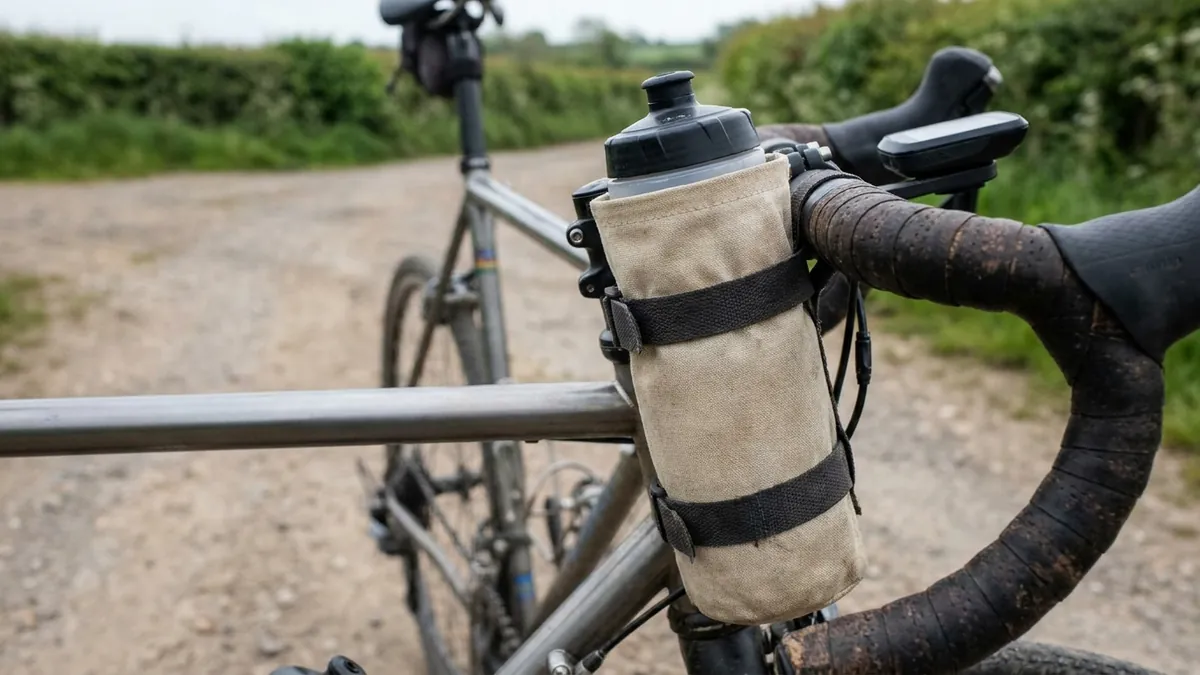
A feed bag is a small cylindrical bag that sits next to the stem. You can reach into it while riding, which makes it the natural place for the bottle you drink from most. Our FEEDER feed bag (16 × 10 cm) can hold a water bottle as long as the bottle fits its size; check the measurements against your bottle before you order. When fitting it, make sure it does not touch the brake cables or get in the way of steering. Other shapes are in our stem and feed bags; on the handlebar side, the FX-1 in X-Pac opens with one hand while you ride.
A pair of feed bags, one either side of the stem, gives you a bottle on one side and snacks on the other. That keeps the frame bag closed for most of the day.
A bladder in the frame bag
A soft bladder lies flat and carries a lot of water in a shape that fits a frame bag. It keeps the weight central and low. The downsides: it uses space you might need for food, the hose has to come out somewhere, and a leak soaks everything packed with it. Most of our frame bags are water-resistant rather than waterproof, and no frame bag is meant to hold a leak. If you use a bladder, pack it in its own compartment and keep electronics elsewhere.
Hip pack or backpack
Water on your body is the last option. It works for a short dry section, but adds weight on your hands and saddle and makes your back sweat. Keep it for emergencies.
What about the handlebar roll?
You can push a bottle into the end of a handlebar roll, and on some trips people do. It is not a good habit. Water is heavy and the bar is the part of the bike you steer with, so extra weight there slows the steering and makes the front wander on rough ground. Keep the roll for light, bulky things and put water lower down. The same goes for the saddle bag, where a full bottle swings with every bump.
Planning how much water to carry
There is no single right amount, because it depends on heat, climbing, your body and how far apart the refills are. A practical way to plan:
- Find the longest gap between refills on your route — shops, villages, springs, campsites with taps. That gap sets your maximum capacity.
- Think about time, not distance. A short section with a long climb on a hot afternoon can take longer and drink more than a long flat one.
- Add dinner and breakfast if you will sleep away from a tap. Cooking and coffee use water too.
- Build capacity you can leave empty. A collapsible bottle or bladder weighs almost nothing when empty; fill it only before the long stretch.
- Test it at home. Load the bike with every bottle full and ride it once. Water weighs about a kilogram per litre, and a fully loaded bike handles very differently.
Putting it together
When you work out how to carry water on a bike, start from the frame. If your triangle holds a full frame bag, water moves to the fork, under the down tube and into a feed bag. If you would rather keep two bottles inside the frame, choose a half frame bag and move bulky gear to the handlebar and fork. Either way, the drinking bottle should be in reach while riding and the heavy reserve should sit low.
In short
- Keep water low and spread across the bike; avoid the handlebar roll and the saddle bag.
- A full frame bag pushes bottles to the fork, down tube and feed bags; a half frame bag keeps them in the triangle.
- Fork cages carry the most, but need mounts and a load check.
- A feed bag beside the stem holds the bottle you drink from, if the bottle fits.
- Plan capacity from the longest gap between refills and carry empty spare capacity.
Questions we get asked
Can a feed bag hold a water bottle?
Yes, if the bottle fits the bag's size. Check the FEEDER's measurements (16 × 10 cm) against your bottle, and make sure the bag does not touch brake cables or steering.
Can I keep bottles in the frame with a frame bag?
With a half frame bag, yes — it sits under the top tube and leaves room for cages below. A full frame bag takes the whole triangle, so bottles move elsewhere.
How much water should I carry bikepacking?
Plan from the longest gap between refills, think in hours rather than kilometres, and add water for cooking if you camp away from a tap.
Is it fine to carry water in a handlebar roll?
It works in a pinch, but heavy water on the bar slows the steering. Keep the roll for light, bulky gear and carry water lower down.
What is an anything cage?
It is the name riders often use for a larger cargo cage on three-bolt fork mounts. It holds a big bottle or a small dry bag; check what load your fork maker allows on those mounts.
Not sure whether bottles will fit under a half frame bag on your bike? Send a side photo and your triangle measurements to [email protected].
About LESENOK
LESENOK makes handmade Colorful Cycling Systems — bike bags for commuting, touring, family rides and bikepacking. Over 100 models, more than 50 colours and prints, custom sizes cut to your own bicycle, and worldwide shipping with tracking. Handmade in Ukraine. In-stock items are processed in 1–3 business days; made-to-order and custom bags are typically produced in 7–12 business days. Questions: [email protected].